
Research News · November 6, 2026
A New Blood Test for CJC-1295 Shows Why That Compound Is Unusually Easy to Catch
A racing laboratory has published an assay that detects CJC-1295 in horse plasma at very low concentrations. The reason it works comes down to the modification that makes the molecule last so long.
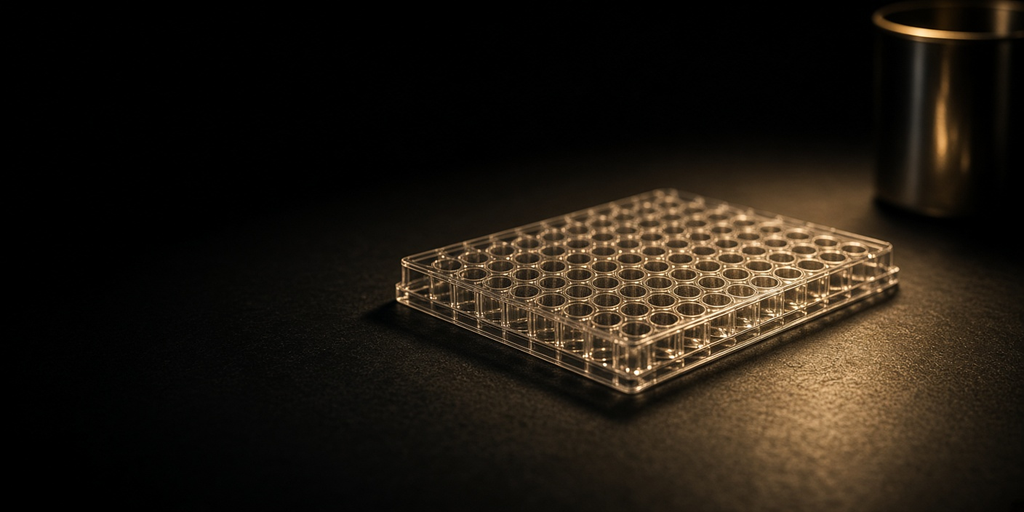
Detecting peptides in blood is difficult. They are small, they are chemically close to molecules the body already makes, and most of them are cleared within hours. Anti-doping laboratories have spent years on the problem, and the usual answer involves mass spectrometry and a narrow window of time after administration.
A paper published in Drug Testing and Analysis in October 2026 reports a different approach for one particular compound, and the reason it works is worth understanding.
What the laboratory built
A team at Racing Analytical Services in Flemington, Australia, developed an ELISA for CJC-1295 in horse plasma. ELISA stands for enzyme-linked immunosorbent assay: a test that uses antibodies, made to recognise one specific molecule, to detect it in a sample. It is a long-established laboratory technique, generally cheaper and faster than mass spectrometry, and suited to screening many samples.
The team raised monoclonal antibodies against the CJC-1295 peptide and built an assay that detects CJC-1295 protein conjugates at concentrations as low as 12.5 picograms per millilitre. A picogram is a trillionth of a gram, so that is a very small amount.
They then tested it on blood samples from thoroughbred racehorses that had received CJC-1295, to show it works on real samples rather than only on spiked ones.
Why this compound in particular
The paper's most useful observation is about chemistry rather than method. CJC-1295 carries a modification called a drug affinity complex, or DAC, which chemically cross-links the peptide to blood proteins that have a free cysteine residue, mainly albumin.
That modification is the compound's selling point: attached to a long-lived blood protein, it is not cleared in hours the way a bare peptide is. According to the Frontiers in Endocrinology review published in June 2026, the DAC form has a half-life measured in days in healthy adults, and raised growth hormone and IGF-1 for days after a single administration in the trials that have been run.
The authors of the detection paper point out the consequence: because it binds to a protein and stays there, CJC-1295 behaves in a sample more like a protein than like a typical peptide. The property that makes it persist in the body is the same property that makes it persist in a blood sample, and so detectable long after a short-acting peptide would be gone.
Why that is unusual
Most of the peptides discussed in this area are not like this. A bare peptide chain is cleared from the body quickly and degrades in a stored sample, which is what makes the analytical problem hard in the first place. The DAC modification was designed to defeat the first half of that, and in doing so it defeats the second half too.
That is a general lesson worth holding on to. Stability is not a property of "peptides" as a category. It varies enormously between molecules, it can be engineered deliberately, and it determines what a laboratory can find and for how long afterwards.
This is a horse study
Everything above was done in equine plasma, using horse samples from racing. Antibodies raised against a peptide generally recognise the peptide itself rather than the species it came from, so the method is plausibly transferable, but that has to be demonstrated rather than assumed. The paper reports an assay for racing samples, and that is what it establishes.
What has not been established
- Whether this assay performs the same way on human samples has not been tested in this paper.
- No detection window is reported here for the version of CJC-1295 sold without the DAC modification, which has a different clearance profile and, as the Frontiers review states, no controlled human studies at all.
- The paper is a detection method. It reports nothing about effects, safety or outcomes.
Why it is worth noting
Reviews of this compound class consistently observe that anti-doping laboratories are actively developing methods to detect them. This paper is a concrete instance: a specific assay, a stated detection limit, and real samples. For anyone following where the analytical science is going, the direction of travel is that these compounds are becoming easier to find, not harder.
Sources
More in Research News

Research News · November 4, 2026
A New Thymosin Alpha-1 Study Links It to Lower Sepsis Deaths. The Largest Randomised Trial Found No Difference.
A 327-patient hospital records study reports a strong association. A 1,106-patient blinded trial did not. Here is why the two can disagree, and which one carries more weight.

Research News · November 3, 2026
Four New MOTS-c Papers. Only One Measured People, and It Was a Snapshot.
October brought a mouse kidney study, an egg-cell study, a computer model and one small human survey of MOTS-c. Here is what each actually measured, and the controlled trial still running.

Research News · October 30, 2026
Two New Reviews Count the Human Evidence for BPC-157. It Comes to 30 People.
A systematic review and an orthopaedic narrative review, both published this month, reach the same finding: decades of animal work, and almost no controlled human data.